Now Booking for 2026/27
A young man, Rana*, approached me after I’d been speaking with his year group about Respectful Relationships at a High School in Perth.
“I’m really struggling to fit in. Being at school is hard when you’re not really in a group. What can I do?”
Just behind Rana stood three of his peers. The middle boy, taller than the others by at least 10cm, had his arms draped across the shoulders of the boy either side of him. They were joking with each other, waiting for their chance to talk to me, oblivious to the discussion I was having with the student beside me.
I interrupted them and asked if I could use them as an object lesson. They agreed.
Turning to Rana, I asked, “Do you think you can fit into this group of guys? Physically, can you make yourself fit?”
He wasn’t sure what I meant so I demonstrated, attempting to squeeze my shoulder and body between two of the boys. It was tricky. I really didn’t fit regardless of how I tried.
“Probably not”, he responded.
“That’s what we keep trying to do though. We keep trying to fit into spaces that aren’t really ours to fit into. We have to change, contort, and make ourselves something we’re not.”
Addressing the boys I then asked, “Boys, I’m going to ask Rana to join you now, not trying to fit in, but as if he belongs. As he moves towards you, what would you do if he belonged.”
Rana hesitantly took three steps toward the boys. One of them lifted his arm and put it around Rana’s shoulder. He was in.
“That’s the difference between fitting in and belonging”, I explained.
I watched as Rana’s body language shifted. His discomfort eased. He smiled and relaxed into his new buddies. There was eye contact, big grins, and laughter.
It’s a distinction that sounds simple, but for a student who spends every lunchtime on the outside of exactly that kind of moment, it can be the difference between wanting to be at school versus staying away, or between finding the motivation and desire to be in a learning mindset versus feeling socially unviable, dropping in self-esteem, It’s the difference between a student who can find the motivation to learn versus one who can’t – because when belonging is missing, very little else works.
School can be tricky when you don’t fit in. But the trickiest part of all is being someone you’re not so you can try to fit in. It’s better to find where you belong.
As teachers, you have more influence over this than you might realise. Research consistently shows that two relationships are all it takes to support a student’s basic psychological need to belong:
First, a student needs a peer to see them walk into the playground or classroom and say “Hey, come sit with us.”
Second, a student needs a staff member who knows them by name, whose eyes smile with delight when they see them, and who is there for them when they feel stuck, academically or socially.
James Forrest, a Queensland primary school principal, covered a wall in the staffroom with cardboard and wrote the names of every student in the school down the left-hand margin. Across the top of the wall he wrote the name of each teacher. Handing out red sticky dots, he asked each teacher to place a dot in the cells of each student where they knew their name and face, and could have a quick chat about something relevant to the student if they crossed paths in the playground.
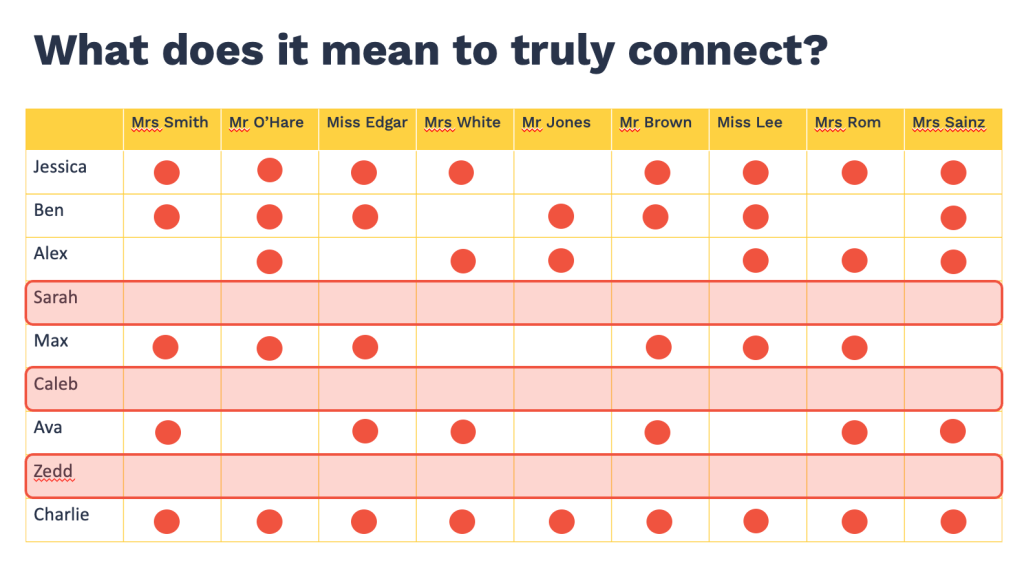
Several students had no red dots. No teacher really knew them. The assignment was clear: find those students and help them feel seen.
Connection is feeling seen, heard, valued, and accepted. Students who feel this from their teachers experience school belonging, something associated with positive outcomes in every domain.
As for peers, psychologists and school wellbeing leaders tell me this is the toughest challenge for kids. And there are no easy answers. But… the more that a student feels seen, heard, valued, and accepted by at least one peer, the more the school environment will feel relationally supportive, and the greater that student’s motivation will be to show up and be involved.
Create an environment that supports those connections, and students will not just want to be at school – they’ll be able to be the best versions of themselves while they are there.
- Think of a student in your class right now who seems on the outside. Do they have a red dot – from you, or from anyone?
- When did you last create a moment – deliberately, not accidentally – where a student felt they belonged rather than just turned up?
- If belonging requires just two relationships, what’s one specific thing you could do this week to help a struggling student find either one?
*Name has been changed
More Keynotes



Let's Start the Conversation
Check Justin's Availability for Your School Community or workplace
 Fill in the form and Caroline will come back to you within 24 hours. Prefer to reach out directly? Email Caroline - she manages all bookings and will make the process straightforward.
Download the 2026 Speakers Kit
Justin's 2026 Education Speaker Kit — bio, synopses, photos, and testimonials.
Download Justin's 2026 Speakers Kit →